 middle place
A mood journal that tracks itself as you write.
Mood trackers are quick but thin: a face and a tap. A journal has the story but no chart. A mood journal is both: how you felt, and why.
Updated 5 November 2026
What is a mood journal?
A mood journal is a journal where you record how you feel along with what happened, so you can look back and see patterns: which days tend to be hard, what lifts you, who leaves you drained or energised. A mood tracker records the feeling alone, usually as a rating or an emoji. The journal adds the context that makes the pattern make sense.
What to record in a mood journal
- How you feel overall, on a simple scale from very unpleasant to very pleasant.
- The specific emotions, in words: anxious, content, irritated, hopeful, lonely. Usually more than one.
- What was going on: where you were, who with, what had just happened.
- The basics that move moods: sleep, food, exercise, time outside, time alone.
- Moments as well as days. A whole day can be fine with one sharp low in the middle, and both are worth writing down.
How to find patterns
Patterns show up over weeks, not days. Every so often, read back over a month and ask: when was I lowest, and what was happening? When was I best? Which people or places keep showing up on good days? Write down anything you notice, and test it: if Sunday evenings are consistently rough, what could make them easier?
Moods in middle place
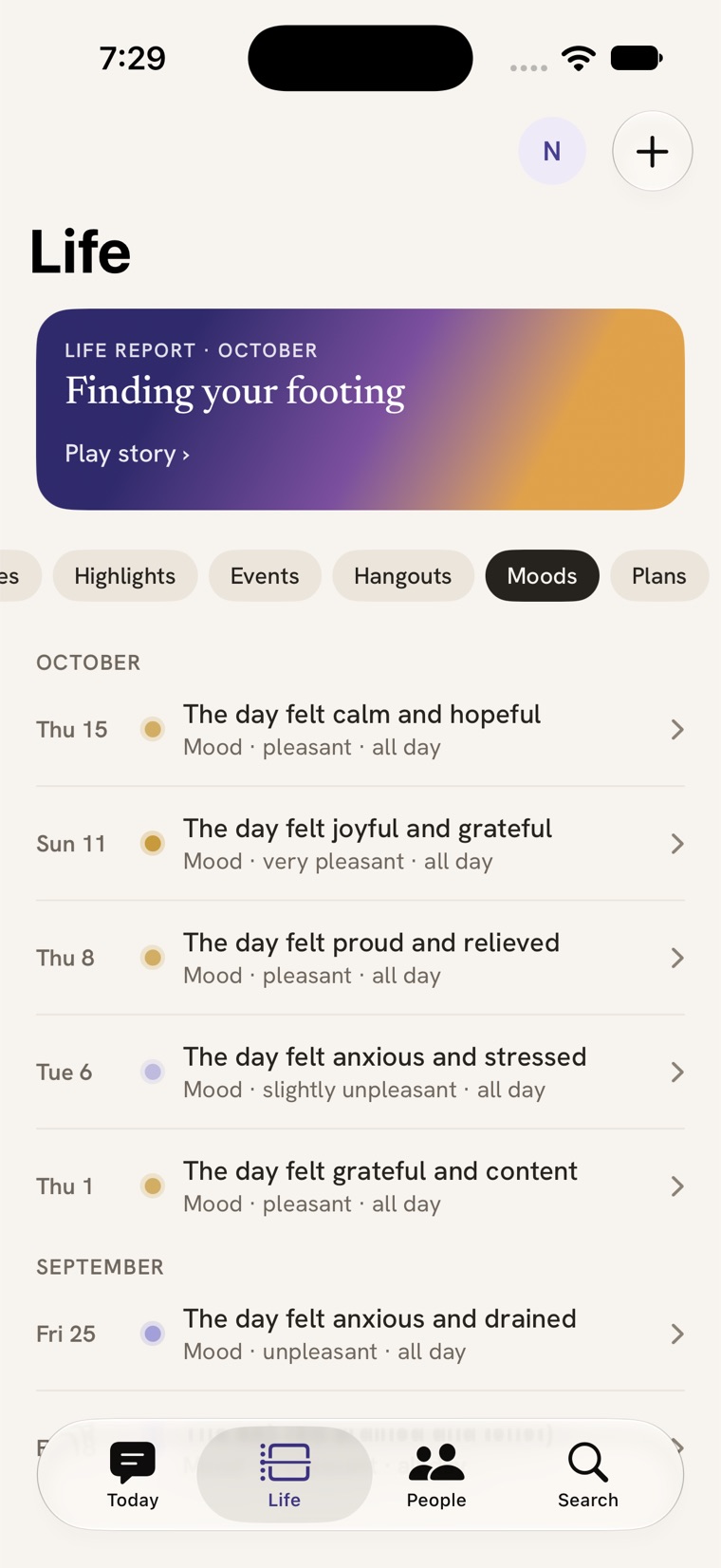
In middle place you don’t fill in a mood form. You write or talk about your day, and when you mention how you feel, it logs a mood without interrupting you.
Each mood is shaped like Apple Health’s State of Mind: how pleasant or unpleasant it felt on Apple’s seven-step scale, plus the emotions by name from Apple’s list of 38, for a single moment or for the whole day. Moods sit on your timeline next to the events, plans and people they belong to, and a Moods filter shows them on their own.
On iPhone and iPad you can have moods saved to Apple Health, and show moods you’ve logged in other apps on your timeline. Both settings are off until you turn them on. Moods are never ranked or turned into highlights; they’re kept as a record and nothing more.
Mood journal questions
What is the difference between a mood journal and a mood tracker?
A mood tracker records how you feel, usually as a quick rating. A mood journal records the feeling along with what happened and why, which makes patterns easier to understand.
How often should I log my mood?
Once a day is a good baseline, plus a note when something shifts your mood sharply. In middle place, moods are logged as you write, so there’s no separate step.
Can a journal app save moods to Apple Health?
Yes. middle place can save the moods you mention to Apple Health as State of Mind entries on iPhone and iPad, if you switch that on. Apple Health isn’t available on Mac.
Should I tell a doctor about mood patterns I notice?
If you notice long stretches of low mood, big swings, or anything that worries you, yes. A mood journal can be a useful thing to bring to that conversation.